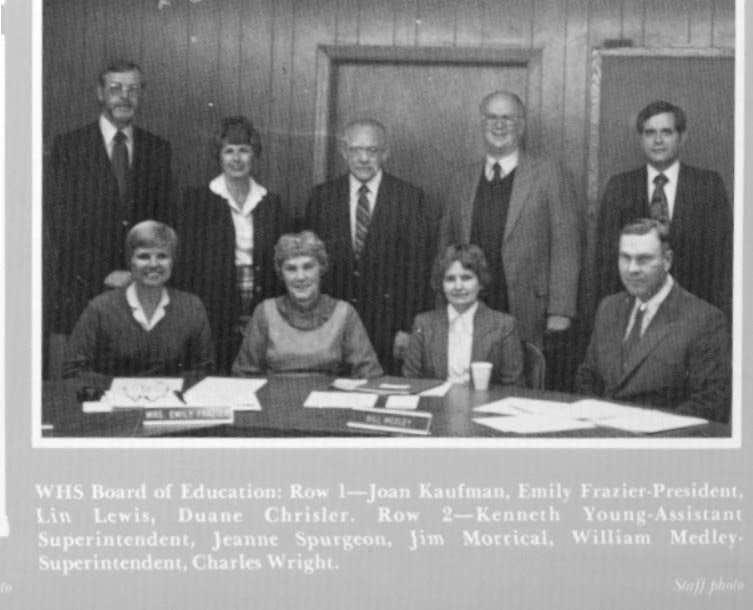
It’s not difficult for me to remember the first time I met Bill Medley. It was the Spring of 1981 and I had just been elected to the USD 465 Board of Education. Jim Reed called and said I was to participate in interviewing candidates for Superintendent. At the district office and later at a local restaurant I met and had my first conversation with Bill and Maxine Medley. We had several good candidates and the decision came down to as Joan Kaufman put it, “When you have a close decision you go with the known quantity.” What a great nine years I had working with Bill, first as colleagues, the he became a mentor, and finally a valued friend.
The next paragraph is an excerpt from one of my earlier columns:
Bill Medley was a high school principal and superintendent in USD 465 for nearly 30 years. Bill became USD 465’s Superintendent the same day I became a new board member in 1981. Several lessons were learned during his tenure, but I will focus on two that I clearly recall. Bill’s goal was to always find them “doing something good.” He included students, teachers, staff, administration, and any other employee. The other lesson was his ability to start the seed of an idea, throw it out to an audience, and watch it come back in developed form. Bill was an example of Emerson’s old quote, “there is no limit to what can be accomplished if it doesn’t matter who gets the credit.” Bill was a master at giving credit and conversely, taking the blame.
It is also not difficult to remember my last two conversations with Bill. I was working in my yard last Fall and he stopped and we visited. He told me how his son Forrest made copies of one of my writings about him and handed them out to employees. We made a plan for me to have coffee with him the next week. At out meeting we reminisced about some of the accomplishments of our time together. Each idea that worked he recalled how I had developed it with him at a board meeting or a trip to Topeka. My recollection was that mostly they were Bill’s ideas that the board and administrators helped develop. That was Bill.
At his celebration service Brilla Scott mentioned his many of his accomplishments and ended saying she thought his proudest was returning to the community he loved as superintendent. I would agree with that and further say that being on the board that brought him back is also one of my proudest moments also. Our thoughts and prayers are with Maxine, Forrest, Jennifer, and the rest of the family. He will be missed!
Thursday, March 26, 2015
Friday, February 27, 2015
The Pursuit of Money
Throughout history and in every society there has been an enduring question about the importance of money. In reality the place of money and the priority of accumulating “things” is an issue that each of us must settle for ourselves.
The apostle Paul gave advice to his young protégé Timothy “For the love of money is the root of all evil” (I Timothy 6:10). So then it is the LOVE of the money not the money itself that is the root of all evil. Like so many things in life it is when we are out of balance about money and seeking for it that we get into trouble.
The love of money has manifested itself in many ways. Wars have been fought, people have been murdered, people have been cheated all for money and often for paltry sums. In another context families have been torn apart when inordinate of time has been spent by a parent or parents grubbing for the almighty dollar. The prsuit of money in an unbalanced way has many potentially negative outcomes.
I remember in the late Steven Covey’ great book “The Seven Habits of Highly Effective People” the comment that “no man when he comes to the end of his life regrets not spending more time at the office.” Work and money are important in this life but the really important things in life- love, family, good health.- cannot be bought. So then what is the purpose of money in our lives?
According to best-selling author John Maxwell money has only two purposes, it gives us options and it allows us the resources to help others. We have the options of where we live, the home we purchase, how we educate ourselves and our children, and even the social groups we develop relationships with. Money cannot buy us happiness, but wise gathering and use of money can allow us to live the life we choose to live. Many don’t and will never have those choices.
The second purpose, having the ability to help others, is really the essence of what life is or at least should be about. A student of mine once completed a class project surveying seventeen religions. She was trying to find what ethical positions they had in common. The dominant principle she found was several variations of the Golden Rule, to do unto others as we would have them do unto us. Having resources allows us to help those less fortunate than us.
My church has a program of supporting our missionaries worldwide. The program takes large amounts of money. Another program, Manna Worldwide helps feed and clothe children in several countries. There are many, many good programs for us to fulfill that second purpose, helping others. It is up to each of us to discover where we want to place our support.
The apostle Paul gave advice to his young protégé Timothy “For the love of money is the root of all evil” (I Timothy 6:10). So then it is the LOVE of the money not the money itself that is the root of all evil. Like so many things in life it is when we are out of balance about money and seeking for it that we get into trouble.
The love of money has manifested itself in many ways. Wars have been fought, people have been murdered, people have been cheated all for money and often for paltry sums. In another context families have been torn apart when inordinate of time has been spent by a parent or parents grubbing for the almighty dollar. The prsuit of money in an unbalanced way has many potentially negative outcomes.
I remember in the late Steven Covey’ great book “The Seven Habits of Highly Effective People” the comment that “no man when he comes to the end of his life regrets not spending more time at the office.” Work and money are important in this life but the really important things in life- love, family, good health.- cannot be bought. So then what is the purpose of money in our lives?
According to best-selling author John Maxwell money has only two purposes, it gives us options and it allows us the resources to help others. We have the options of where we live, the home we purchase, how we educate ourselves and our children, and even the social groups we develop relationships with. Money cannot buy us happiness, but wise gathering and use of money can allow us to live the life we choose to live. Many don’t and will never have those choices.
The second purpose, having the ability to help others, is really the essence of what life is or at least should be about. A student of mine once completed a class project surveying seventeen religions. She was trying to find what ethical positions they had in common. The dominant principle she found was several variations of the Golden Rule, to do unto others as we would have them do unto us. Having resources allows us to help those less fortunate than us.
My church has a program of supporting our missionaries worldwide. The program takes large amounts of money. Another program, Manna Worldwide helps feed and clothe children in several countries. There are many, many good programs for us to fulfill that second purpose, helping others. It is up to each of us to discover where we want to place our support.
Saturday, January 31, 2015
Common or Committed?
I do not choose to be a common man.
It is my right to be uncommon … if I can.
Those words were penned by Thomas Paine in 1776 and are true today. They reveal one of the truths about us rising above the mundane and committing our lives- it is a choice! We make those choices throughout our business or personal lives. We can follow the crowd and take the easy way or dare to try excellence as our goal. In the end it is up to each of us to choose to be common or committed!
Another truth about leaving the common and being committed is the place of failure in our lives. I know of no great success achieved without some if not great failure along the path, Disney failed as did President Lincoln. Richard Nixon lost the presidency, went home and lost the California Governor’s race, and later was elected in one of the greatest landslide elections in our history as a country. Ronald Reagan became president on his third attempt. As W. Clement Stone once wrote “Success is achieved by those who try and keep trying (being committed).
Fear of failure might be the single greatest reason well fall short of what we might become and thus never really commit to any task, goal or life pursuit. Teddy Roosevelt had it right when he wrote “Far better is it to dare mighty things, to win glorious triumphs, even though checked by failure...than to rank with those poor spirits who neither enjoy much nor suffer much, because they live in a gray twilight that knows not victory nor defeat.” We must step out of our comfort zone if we are ever truly going to be committed.
The first two years of my insurance career were tarnished by spotty production and a willingness to go along with the crowd. Given great training I had a desire to excel but a commitment to the easy path. During a twenty-five week business insurance class I learned much and saw examples of people choosing to be committed and the lessons changed my path forever.
At the end of his great poem “The Road Not Taken” Robert Frost wrote “I took the one less traveled by, and that has made all the difference.” That is the third truth about leaving the common and moving to the committed. The road will not be crowded. Others will try and divert us and get us to travel the easy path. Obstacles and diversions will try and sidetrack us as we travel life’s journey. We must forge ahead to reach being the uncommon and to remain committed to our future!
Monday, December 1, 2014
Getting Things Done!!
Much has been written about how to get things done through people. There are several theories of motivation, each having an element of truth and success. After studying and trying most of them for over forty years I have come to the conclusion I can’t motivate anyone, but can just put someone in a position to motivate themselves and reach for what they want.
Why have I come to that conclusion? I have read books and listened to speakers on motivation for years. After a few days their benefits have waned unless I made a conscious effort to keep the effect going. Most people are not willing to make the effort to keep up the effect, so as leaders we must find a way to do it for them. My system for putting followers in a position for self- motivation comes in three steps. They are, as follows:
First, it is important to create an atmosphere. We want them to be in a positive position for accomplishment. We must get to know our people and what THEY want from our organization or team. When we know them we also must prepare them with training needed to accomplish their tasks. Someone has said “nothing succeeds like success” so we must allow them small victories, and yes even some failures, to move toward their own goals for growth. Along the way we involve the team in goal setting so it becomes OUR plan and not just something that we are handed without input.
When we have successfully created the desired atmosphere we then must move on to the second step, contributing to our success. We do this first by understanding that we too must grow and continue getting better at what we do. We lead by example and in so doing contribute to our and their success. This step is a continuous process because each person needs something different from us and as they grow what they need changes. A key to contributing to our success is remaining flexible to the ever changing needs of our staff or team. One of my former managers once said “never ask someone to do what you haven’t or wouldn’t do”. We contribute to our success by getting “in the trenches” with them!
The final step is to always celebrate our victories. These celebrations come on at least two levels. As we are progressing towards a goal we must have small celebrations that recognize our progress and those responsible for the achievement. When the big picture goal is reached we should also celebrate, but on a larger scale. Each step along the way should be marked with meaningful recognition for all involved. We want to give credit where it is due and to make it vocal and valuable. By doing these things we make it not my victory, but our victory and we are “getting things done!”
Contact Chuck at: chuck.wright@sckans.edu
Why have I come to that conclusion? I have read books and listened to speakers on motivation for years. After a few days their benefits have waned unless I made a conscious effort to keep the effect going. Most people are not willing to make the effort to keep up the effect, so as leaders we must find a way to do it for them. My system for putting followers in a position for self- motivation comes in three steps. They are, as follows:
First, it is important to create an atmosphere. We want them to be in a positive position for accomplishment. We must get to know our people and what THEY want from our organization or team. When we know them we also must prepare them with training needed to accomplish their tasks. Someone has said “nothing succeeds like success” so we must allow them small victories, and yes even some failures, to move toward their own goals for growth. Along the way we involve the team in goal setting so it becomes OUR plan and not just something that we are handed without input.
When we have successfully created the desired atmosphere we then must move on to the second step, contributing to our success. We do this first by understanding that we too must grow and continue getting better at what we do. We lead by example and in so doing contribute to our and their success. This step is a continuous process because each person needs something different from us and as they grow what they need changes. A key to contributing to our success is remaining flexible to the ever changing needs of our staff or team. One of my former managers once said “never ask someone to do what you haven’t or wouldn’t do”. We contribute to our success by getting “in the trenches” with them!
The final step is to always celebrate our victories. These celebrations come on at least two levels. As we are progressing towards a goal we must have small celebrations that recognize our progress and those responsible for the achievement. When the big picture goal is reached we should also celebrate, but on a larger scale. Each step along the way should be marked with meaningful recognition for all involved. We want to give credit where it is due and to make it vocal and valuable. By doing these things we make it not my victory, but our victory and we are “getting things done!”
Contact Chuck at: chuck.wright@sckans.edu
Saturday, November 8, 2014
Saying Thanks!
November has rolled around again, the year is winding down, and many of our thoughts turn to those things and those for whom we are thankful. Really this should be a year around activity but it seems we get too busy to stop and be thankful and to say thanks. In this land of plenty it is easy to develop and attitude of entitlement and not realize how blessed we are. My list is certainly not all-inclusive and I’ll think of something left out, but I’ll share some of the items that deserve my saying thanks.
Thanks to God for being born in this great nation. I am free to worship how I want, work where I want, and live where I want. Those and other freedoms are only possible because of those sacrificing, even dying, so that I and others could exercise our freedoms. Changing our government by ballot and not by bullet is another wonderful freedom. We’re even free to call others stupid and uneducated because they choose to vote differently than we do.
Thanks to my wife of forty-nine years and all the joys and sorrows we’ve shared. I decided long ago that she was a keeper and one of the few people (maybe the only one) that could put up with me. In those early days I thought she was the nicest and the smartest person I ever met. I was right. I’m hoping for many years to share our common interests- our faith, our family, and our friends.
Thanks for our families, close and distant. Our daughters, grandchildren, mothers, sisters, cousins, etc. have added joy to our household. We have shared many special occasions, joys, and sorrows. We have had great opportunity to share with you in our home and in distant places. As Debbie Boone once sang, “You light up my life.”
Thanks to those sacrificing to keep us safe. Our police, firefighters, and yes, our military serving on foreign shores all deserve our thanks. Our lives happen so peacefully and matter of fact that we too often forget the risks you take to provide our everyday lives. An ordered society is dependent upon each of you to keep us from chaos.
Thanks for the opportunity to have two great careers. The sales and sale management career of my youth and the teaching career I’ve had in my mature years. Both have been a blessing and added to my life. I continually learn from the students taking my classes.
These are just a few things I have to say thanks about. Think of yours and remember to say thanks for those providing them. Also, have a great Thanksgiving!!!!
Thanks to God for being born in this great nation. I am free to worship how I want, work where I want, and live where I want. Those and other freedoms are only possible because of those sacrificing, even dying, so that I and others could exercise our freedoms. Changing our government by ballot and not by bullet is another wonderful freedom. We’re even free to call others stupid and uneducated because they choose to vote differently than we do.
Thanks to my wife of forty-nine years and all the joys and sorrows we’ve shared. I decided long ago that she was a keeper and one of the few people (maybe the only one) that could put up with me. In those early days I thought she was the nicest and the smartest person I ever met. I was right. I’m hoping for many years to share our common interests- our faith, our family, and our friends.
Thanks for our families, close and distant. Our daughters, grandchildren, mothers, sisters, cousins, etc. have added joy to our household. We have shared many special occasions, joys, and sorrows. We have had great opportunity to share with you in our home and in distant places. As Debbie Boone once sang, “You light up my life.”
Thanks to those sacrificing to keep us safe. Our police, firefighters, and yes, our military serving on foreign shores all deserve our thanks. Our lives happen so peacefully and matter of fact that we too often forget the risks you take to provide our everyday lives. An ordered society is dependent upon each of you to keep us from chaos.
Thanks for the opportunity to have two great careers. The sales and sale management career of my youth and the teaching career I’ve had in my mature years. Both have been a blessing and added to my life. I continually learn from the students taking my classes.
These are just a few things I have to say thanks about. Think of yours and remember to say thanks for those providing them. Also, have a great Thanksgiving!!!!
Wednesday, September 17, 2014
Laugh, Cry, Pray!
Recently I was visiting my Mother at Cumbernauld Village. As I was leaving I ran into George Lowe. His mother had recently moved into the facility. We were lamenting the direction of our mothers’ health. As our conversation ended George remarked that when dealing with these kinds of issues he tried to laugh, cry, and pray. The more I thought about it the advice was not only good for where we were with our mothers, but just about everything that happens in life.
Doctors have long held that laughter is good for us. Readers Digest has a section called “Laughter is the Best Medicine” and wise King Solomon wrote “a cheerful heart is good medicine” in Proverbs 17:22. Laughing is often contagious. People seeing others laugh get involved despite often not knowing the topic at hand. At the end of a good laugh everyone feels better.
My prior district manager once told me that while we are involved in many serious activities it is important not to take ourselves too seriously. Sometimes the most laughable situations are those we get into because we “do dumb.” We can either let these times get us down or have a good laugh and move on. I’ve had several laughs at myself over the years.
The ability to cry is also very important. For much of my life the conventional wisdom has been that real men don’t cry. When our girls were young we would watch a television show with a sad ending. The girls and their mother would have tears running down their faces. To me it was just a story. My wife often said she hated to see what would make me cry. That time came in August, 1989 when my dad passed from this life.
Crying is also a good release of the emotions and seems to clear our sensory system. We cry not only for loss or bereavement but also for joy or in appreciation. Often when we are surprised in a positive way many respond with tears. We get involved with someone crying and tears of compassion flow.
I remember several years go seeing a sign “Prayer Changes Things.” My experience over the years validates that message. Prayer is as much an attitude as a specific event. It is the recognition that a power larger than us controls all the events of life. We can pray selfishly but are more effective when our petitions are in behalf of others with needs.
What is the power of prayer? James, the writer of the New Testament book wrote “the effectual fervent prayer of a righteous man availeth much.” In other words the power of prayer is enormous. I know that my Grandmother’s prayers were often and powerful on my behalf. Thanks George I’m glad we had our brief conversation. When the stresses or joys of life come, as they certainly will, I plan to laugh, cry, and pray!
Sunday, September 7, 2014
Transitions!
It seems that life is full of transitions. About the time we get comfortable with some aspect of our life it changes. We don’t go from stability period to stability period; but when things change, we have to grow to the next time that is stable for us. Making the transitional time a growth time is important. Transitions happen in several ways. Let’s look at a couple of ways transitions are necessary.
Sometimes we see something lacking in an aspect of our life and we chose to change. In front of us is a picture of where we want to go that will take some intermediate steps. We might see that we lack the skills for a part of our job. The transition may be filled with training, planning and continuing to focus on where we want to go. We may go through several transitional stages before the desired result is attained.
At other times a change is thrust upon us. We lose a job or perhaps someone that has been an important part of our life. Or the change may be a new computer system at our office. We must adjust and move on with our next phase of life whether it is our preference to do so or not. The transition is not always easy but it is necessary. Often we need to reach out to others to aid us in this process. Someone may have faced a similar change that would enable them to offer valuable assistance.
Whether we choose the change or it chooses us, the transition period can be a time of opportunity or frustration. Difficulties are bound to happen during this critical period. How we face transitions often determine ultimate success and duration of the transition period. Successful transitions aid in getting us comfortably into another time period of stability.
A wise man once told me “this too will pass.” Both periods of stability and times of transition follow his rule. They all pass. Another wise person has said that long term success in life requires us to have the ability to “roll with the punches.” Having this flexibility allows us to transition into the next successful aspect of our life. The only real constant in life is change and the transitions that come with those changes.
Sometimes we see something lacking in an aspect of our life and we chose to change. In front of us is a picture of where we want to go that will take some intermediate steps. We might see that we lack the skills for a part of our job. The transition may be filled with training, planning and continuing to focus on where we want to go. We may go through several transitional stages before the desired result is attained.
At other times a change is thrust upon us. We lose a job or perhaps someone that has been an important part of our life. Or the change may be a new computer system at our office. We must adjust and move on with our next phase of life whether it is our preference to do so or not. The transition is not always easy but it is necessary. Often we need to reach out to others to aid us in this process. Someone may have faced a similar change that would enable them to offer valuable assistance.
Whether we choose the change or it chooses us, the transition period can be a time of opportunity or frustration. Difficulties are bound to happen during this critical period. How we face transitions often determine ultimate success and duration of the transition period. Successful transitions aid in getting us comfortably into another time period of stability.
A wise man once told me “this too will pass.” Both periods of stability and times of transition follow his rule. They all pass. Another wise person has said that long term success in life requires us to have the ability to “roll with the punches.” Having this flexibility allows us to transition into the next successful aspect of our life. The only real constant in life is change and the transitions that come with those changes.
Subscribe to:
Posts (Atom)


